
Waterproof Microcement for Wet Rooms
The Question No One Wants to Answer at the Site Visit
When a contractor in a Dubai high-rise fits out a penthouse bathroom, the owner's first question is: "Will that finish actually stop water?" It should not need to be asked. Yet microcement's rapid spread across residential and commercial interiors has outpaced the industry's habit of specifying a complete waterproof system around it. For contractors, designers, and developers, the difference between a microcement wall that holds for ten years and one that delaminates in eighteen months comes down to a single decision: whether you build the waterproof protocol into the specification from day one, or bolt it on as an afterthought.
Why Standard Microcement Fails in Wet Zones
Apply standard microcement over a bare concrete or gypsum-board substrate with no additional water barrier,and the outcome is predictable. The cement-based body is porous at a micro-scale. Standing water from showers, sinks, or outdoor rain penetrates those pores, wicks into the substrate, and within 12 to 18 months triggers three visible failures:
Substrate swelling and edge delamination, showing up as bubbling at floor-to-wall junctions
Efflorescence and surface clouding, worst on light-grey and white finishes
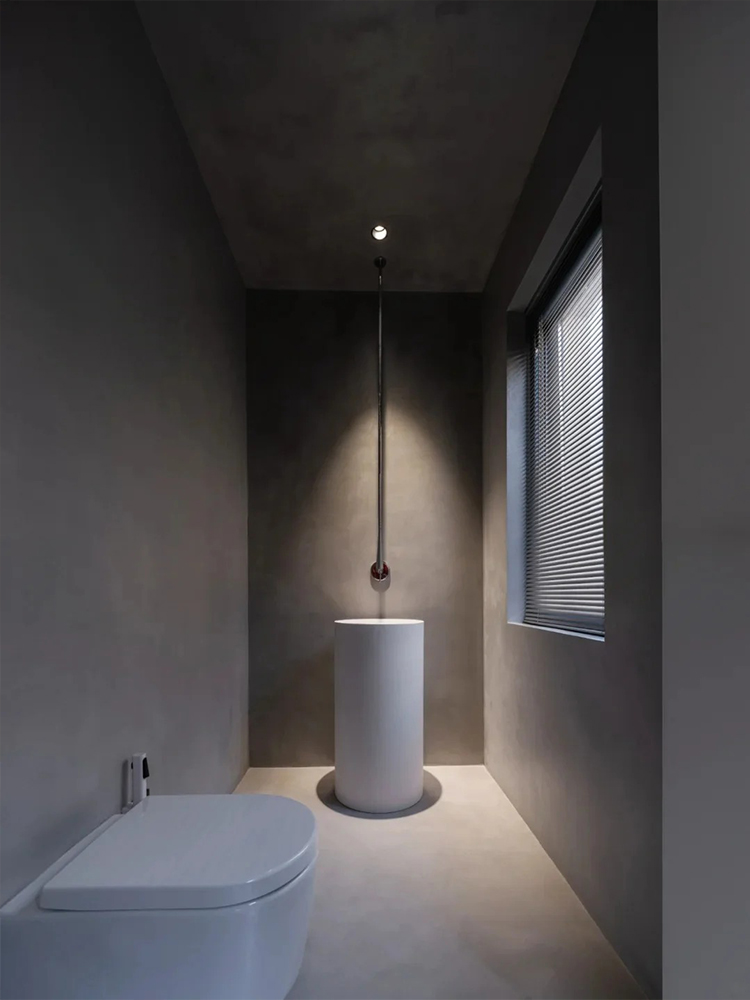
Mold colonies at micro-pores around drains, internal corners, and pipe penetrations
The culprit is not the microcement binder itself. It is the absence of a continuous, low-porosity water-blocking layer above and a flexible membrane below. Without both, the finish acts as a wicking channel rather than a barrier, and no amount of trowel work will fix the underlying physics.
The Three-Layer Build-Up That Holds Up on Site
Installers across the Middle East and Southeast Asia who have moved from repeated failures to reliable, long-lasting results follow the same three-layer sequence:
Layer 1 – Substrate Barrier. A polymer-modified flexible waterproof membrane is brushed or airless-sprayed onto the prepared substrate (concrete, existing tile, cement board, or moisture-rated gypsum board). Minimum 24-hour cure before the next step. This is the primary water-stop; every layer above depends on it.
Layer 2 – Microcement Build. Two to three coats of water-based microcement, totaling 2–3 mm in thickness, are applied by hand-trowel or airless spray. Each coat is mechanically sanded between applications to lock inter-layer adhesion. On large multi-room projects, spray application cuts wall-covering labor time by roughly 40% compared with pure hand-troweling, a meaningful saving on hotel or apartment packages where labor is the dominant cost line.

Layer 3 – Protective Top Seal. Two coats of a low-porosity penetrating or film-forming sealer close the remaining surface pores and bring water absorption below 0.05 mL/cm². The finished surface becomes wipe-clean and resists the daily moisture cycles of a shower room, kitchen splash zone, or pool deck.
The total build-up sits between 4 and 6 mm, thin enough that door and window clearances in a renovation are unaffected, and the finish does not encroach on furniture placement.
Side-by-Side: What the Numbers Actually Show
The epoxy-seal route delivers decent moisture resistance, but its application demands strict ventilation, short pot-life windows, and a higher skilled-labor threshold. For most residential and commercial wet-room projects, the three-layer water-based system delivers the right balance of performance, ease of installation, and long-term durability without the chemical-handling headaches.
What the Specification Should Actually Say
"Waterproof microcement" is not a single SKU you pick off a shelf; it is a specified system with three distinct layers, defined cure times, and a measured absorption target. Contractors who write the full protocol into tender documents, designers who call out the top-seal specification on their drawings, and developers who standardize the sequence across residential and commercial wet rooms will see the finish perform for a decade or more. Treat the waterproof build-up as the core specification, not a value-engineering line you can delete when the budget tightens, and the project holds up on schedule and on budget.
Why Choose THE AIKE for Waterproof Microcement Projects
One supply chain for the full waterproof build-up. THE AIKE's microcement range ships with a matching flexible waterproof primer and low-porosity top seal, so your team sources Layers 1 through 3 from a single manufacturer with batch-to-batch consistency—no compatibility guessing, no multi-vendor coordination.
Eco-friendly, VOC-free water-based formulas, globally certified. Every product in the system meets international green-building standards, making it a natural fit for LEED, BREEAM, and Middle East green-project specifications without sacrificing waterproof performance.
Spray + trowel dual application support. Our senior technical team provides project-specific application guides, full color and texture customization, and on-site troubleshooting for everything from a single apartment bathroom to a 200-room hotel wet-area package.
Complete export and compliance documentation. Test reports, trade documents, and full certification packages are included with every shipment, clearing customs and project-submission hurdles on the first pass.
Contact us today for a free product sample and a customized waterproof coating solution tailored to your wet-area project.
“ Contact AIKE Team ”
__________
在线留言
Name*
E-mail*
Country*
Application Areas*
Tel / WhatsApp
Requirement
Business Supervisor:Mr. Bin Zhu


Social media account


